
Local visibility: the small business guide, from Google to Apple Maps

Before they push your door, your customers push a search engine's. Most often Google: they type your trade and their town, look at the map, compare three names and call. More and more, also Apple Maps from an iPhone, an AI assistant, or your website directly. This guide describes the four workstreams that decide whether the name they pick is yours, in the order to run them, with real numbers from one of our clients to set honest expectations. The numbers come from Google, because that is where everything is measured today; the method holds for every point of contact. It applies anywhere, and especially if you run an English-speaking business in France, where your customers search in two languages.
What the numbers of a real client show
An independent garage in Provence, whose online presence we manage, recorded over six months, without spending a euro on advertising:
- 45 phone calls made directly from its Google profile (a "call" = a tap on the call button);
- 347 direction requests to the workshop;
- 39 website visits from the profile;
- calls growing steadily, from about 4 a month at the start to around fifteen now.
Look at the ratio: for this kind of business, calls and direction requests from the profile outnumber website clicks ten to one. Customers call or start navigation without ever opening a web page. In fairness: this client's website is younger than the profile, live only since late May. But the most interesting observation is elsewhere: since the website was linked to the profile, the profile's own statistics have grown, website clicks included. The two tools do not compete, they reinforce each other. That is the first lesson of this guide: for a local business, visibility starts with the profile, and the website amplifies it: it reassures the person who checks before calling, and catches the searches where no map appears.
The 4 workstreams, in order
- Your Google Business Profile. Claimed, complete, with the right category and real photos. The fastest lever.
- Customer reviews. Asked for at the right moment, with a direct link, and every one answered.
- A website with local signals. Town and service area in the text, one page per service, structured data.
- Consistency everywhere. Same name, same phone, same area on the profile, the website, social networks and directories.
Workstream 1: your Google Business Profile
Your Google Business Profile is your real homepage, even if you never created it: Google often displays one, with or without you. Claiming it takes minutes and changes who controls your opening hours, your phone number and your image.
The settings that matter most: the exact primary category, a description that names your services and your area, hours kept up to date, real photos of your work. We detail every setting, with the garage's numbers, in Google Business Profile: the practical guide to being found (and called).
"Garage near me", "hairdresser open now": a growing share of local searches, especially voice searches, no longer even names the town. Google answers them with the map, combining your profile's category, proximity and the profile's recent activity. Those are the searches the profile is built for: the website alone never appears there.
Workstream 2: reviews, the lever everyone postpones
Reviews decide twice: they can contribute to your local ranking, and above all they decide the click. Between two neighbouring businesses, the one showing 27 recent reviews wins the call against the one with 3, even if it ranks slightly lower.
The good news: getting reviews requires no budget and no software, only a method and regularity. The right moment to ask, the direct link that avoids five taps, the answer to every review including the negative one: it is all in Google reviews: how to get more, without buying or faking them. You will also find a lesson we learned the hard way about free review widgets.
Workstream 3: a website that sends local signals
The website remains essential, but not for the reason people assume. It serves first as proof: the person hesitating between two profiles opens the website and decides in thirty seconds. It then catches the searches without a map: all the questions people ask before they have chosen a provider. And if your customers are international, a bilingual site catches searches in both languages, something the profile alone cannot do.
For that, the site must name your town and service area in the text, not only in the footer. And name them for real: "plumber in Manosque", "B&B in Gréoux-les-Bains", "garage in Valensole". Nobody searches "in Provence" alone; your customers type a trade and a town, or a trade "near me". One page per service works better than one page listing ten services. The basics are covered in Local SEO: how to make your business visible on Google, and the matching service is described on our local SEO & Google page.
Workstream 4: consistency, the invisible work that breaks ties
Google cross-checks everything it finds about you: profile, website, social networks, directories, local press. If the phone number differs between the profile and the site, if the name is spelled three different ways, the machine doubts, and doubt costs positions. Choose one canonical version of your name, phone and area, and align everything else with it. It is an hour of work that keeps paying for years.
Local visibility is not an expense, it is an asset: every review, every photo, every page adds up and stays.
Google is no longer the only door
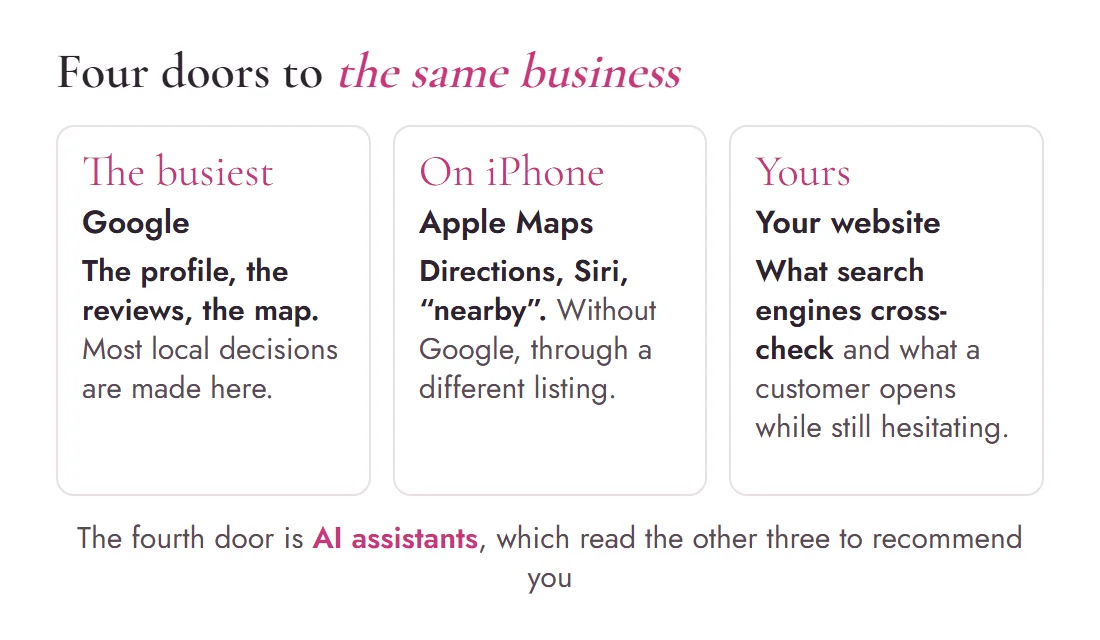
The four workstreams were written for Google, and that is still where most local decisions are made. But three other doors open onto the same business, and they feed on the same information. Apple Maps, first: on an iPhone, directions, Siri search and part of the "nearby" suggestions go through the Apple listing rather than Google; in the Apple listing, a ten-minute check we explain how to see what the iPhone shows about you. Your website, next: it is what search engines cross-check to verify the profile, and what a customer opens when still hesitating; a website's local signals therefore serve both. AI assistants, finally, which recommend a business from what they read on the profile, the reviews and the site, then send the person to a page they have never seen: the landing page that convinces a stranger. Workstream 4, consistency, is what holds the four doors together: same name, same phone number, same opening hours everywhere, Apple included.
How long it takes, and what to expect
Honest orders of magnitude, observed on our clients, not promises:
- Weeks 1 to 4: the completed profile starts appearing on more searches; first reviews, first direction requests.
- Months 2 to 3: calls from the profile become regular; the website starts ranking for specific service searches.
- Months 4 to 6: the trend shows in the statistics, like the garage's climb from 4 to 15 monthly calls. Time to add service pages and target the searches still sitting on page 2.
What makes most businesses fail is not difficulty, it is giving up after three weeks.
The 10-point self-check
Keep this list, it is enough to know where you stand. Every "no" is a workstream:
- My Google profile is claimed and I can edit it.
- The primary category matches my trade exactly.
- My opening hours are correct, public holidays included.
- The profile shows real, recent photos of my work.
- I received at least one review in the last 3 months.
- I reply to every review, positive or negative.
- My website names my town and service area in the text.
- Every important service has its own page.
- Name, phone and area are identical everywhere online.
- I check my profile statistics at least once a month.
Frequently asked questions
Do I have to pay to appear on Google?
No. The Google Business Profile, reviews and organic ranking are free. Google Ads is a possible accelerator, not a prerequisite: our garage client got 45 calls in six months without any advertising, only with a complete profile and a consistent website.
Google profile or website: where should I start?
For a local business, start with the Google profile: it is the fastest lever and most customers call directly from the map. The website comes right after, to reassure those who compare and to catch searches without a map. Each reinforces the other.
How long before I see results?
The first signals, more views and direction requests, usually appear within a few weeks. Regular calls and durable positions build over 3 to 6 months. Consistency beats intensity: one photo and one review a month works better than ten in January and then nothing.
I have no shopfront, does local visibility concern me?
Yes. A mobile or home-based business can define a service area in its Google profile and target "trade + town" on its website. Mobile tradespeople, practitioners and consultants catch the same local searches as businesses with a window.
What should I measure to know it works?
Three numbers are enough at the start, all visible in your Google profile statistics: calls, direction requests and clicks to the website. Note them monthly. If the curve rises, the method works; if it stalls, one of the 4 workstreams is behind.
More questions? Many answers are already gathered on our FAQ page.
Where does your visibility actually stand?
We review your profile, your reviews, your website and your local competitors, in French and in English, and tell you which workstreams to open first. The first call is free.

Written byMaryna Skachek holds a PhD in biology, is a qualified e-commerce project manager and the founder of MariCleo Studio. She writes about digital strategy, content and the professional uses of AI.