
When an AI recommends your business: the landing page that convinces a stranger

We spent the summer explaining how to get cited by an AI. Nobody said what comes next. When an AI assistant recommends your business, it does not take the payment: it sends the person to you, to one page, with a sentence in their head and thirty seconds of patience. That page decides everything, and almost nobody builds it for that visitor.
What just happened, and why it concerns you
On 29 September 2025, OpenAI launched Instant Checkout, with the idea of letting people buy directly inside ChatGPT. On 24 March 2026, the company acknowledged that this first version did not give merchants the flexibility it aspired to, and refocused the experience on discovery, leaving merchants in control of conversion and payment. The Information had broken the story on 6 March.
At Walmart, according to its product lead quoted by WIRED, products bought directly inside ChatGPT converted three times worse than those that sent people to the site. At the same time, ChatGPT was bringing in about twice the rate of new customers compared with search engines. The signal is interesting, and it says no more than this: AI can open the door. The merchant's page still has to do the rest, and the customer wants to see the shop before paying.
Agent-initiated payment has not gone away. Google launched its UCP protocol in January 2026, co-developed with five commerce players and endorsed by more than twenty others. In June, Visa and OpenAI announced a shared infrastructure to secure payments initiated by agents, with no rollout timeline. The architectures keep moving, and they move far faster than a small business can rebuild its website. That is not a reason to rebuild it after every announcement. It is a reason to invest in what survives every architecture: the page the customer lands on.
Added on 5 September 2026. On 3 September, OpenAI announced GPT-6 Astra, a model that uses a computer like a person, and began rolling it out to a limited set of organisations. According to the announcement page, it fills in online forms, updates customer records, organises a calendar, runs research and drafts the summary. The visitor with no context described below may therefore, more and more often, be an agent acting for a customer. An agent does not need a site built for robots: it needs the same clear path as a hurried human, explicit buttons, labelled fields, understandable error messages, no needless blocking step. That does not guarantee it will get to the end, but it removes friction for everyone. Everything that follows applies to both.
The visitor with no context
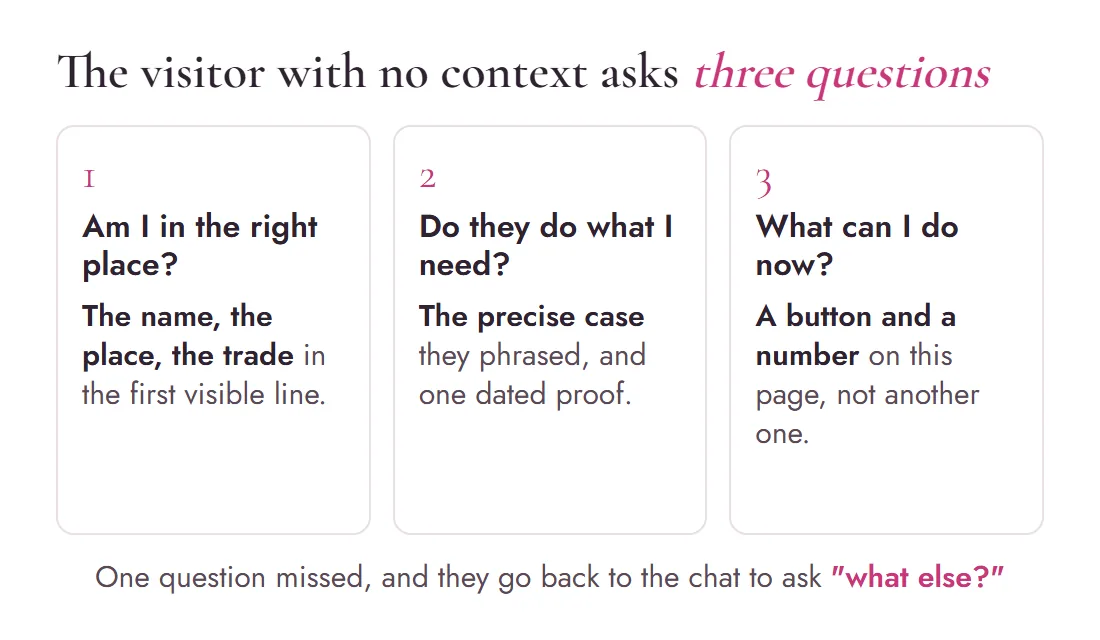
Take a moment to describe this visitor, because they do not look like the people most websites are written for. They did not type your name. They did not browse your home page, your "about" page or your portfolio. They asked an assistant a question, something like "who can redo a tiled roof near Forcalquier", and got a written answer that mentions you, with a link. They click. They arrive in the middle of your site, often on a service page or an article, and they ask themselves three questions in this order, within seconds: am I in the right place, do these people do what I need, what can I do now.
If the page answers all three, they stay. If it misses one, they go back to the conversation and ask "what else". The competitor is one sentence away, and will not hold it against you.
Question 1: am I in the right place
The first visible line must say who the page is useful to and for what, in the words the customer uses, not the trade's. "Roofing and zinc work, family business since 1994" describes the company. "Leaking roof, tiles to replace, call-out in Haute-Provence within 48 hours" describes the reader's situation. The first reassures peers; the second reassures the person who has just arrived. You can keep both, but in that order, with the second at the top.
Look too at what the page does not say. Many service pages assume the reader has already seen the home page and knows the town, the team, the name. The visitor with no context has seen nothing. The company name, the area covered and the trade must appear in the first screen, without needing to go back up to the menu.
Question 2: do these people do what I need
This is where the assistant has exposed you. It phrased a precise need, and the visitor arrives with that phrasing. If your page speaks in general and they are searching in particular, the gap shows. A service page listing eight offerings in three words each answers nobody. A page that takes one case, describes it, shows a real job with a photo you took, and gives a rough idea of lead time or price, answers someone.
One proof beats three adjectives. A dated customer review, a job-site photo with the place, a figure you can defend. The visitor who comes from an AI has just been trained, in the conversation before, to expect concrete answers. They have no patience for "a passionate team at your service".

Question 3: what can I do now
The third question is the one websites miss most, and we have already written about it for the home page: a site that informs and a site that works are not the same object. On a landing page the rule is stricter still. The action must be reachable without leaving the page, without hunting for a menu, without going through a generic "contact" page. A short form at the bottom, a tappable phone number, a booking button: one is enough, as long as it is visible on a phone and says what happens next. "Reply within 48 working hours" does more for conversion than any visual.
And one thing the reader will not see, but you will: each type of enquiry must be distinguishable in your analytics. If, in a month, you cannot say how many enquiries came from this page and by which route, you will not know whether the work paid off either.
Why the home page is the wrong landing page
The temptation is to send everything to the home page, because it is the most polished. That is an error of perspective. The home page speaks to someone who already knows you a little, who searched your name or followed a link from your Google listing. It presents the whole. The visitor with no context has one precise question, and the whole drowns them. They do not want to choose between six services, they want to know whether theirs is there.
The right landing page is therefore a service page or an article that treats exactly the case they phrased, and that contains in itself what it takes to answer the three questions. Unsurprisingly, it is also what classic search engines and AI assistants prefer to cite: a page that answers one precise question, with the name, the place and the action inside it. The work to get cited and the work to convert are not identical, but they reinforce each other: a precise, self-contained, concrete page is easier to understand, for an assistant and for its visitor alike.
A twenty-minute exercise
Ask an assistant, ChatGPT or another, the question a customer would ask to find your trade in your town. Follow the link it gives to your site, if it gives one. Otherwise, open the relevant service page yourself on your phone, as a visitor, as if you did not know the company. Time it. How many seconds to know whether you are in the right place, whether the need is covered, and where to act. Note what is missing. In most cases the list fits in three lines and gets fixed in a morning.
This is not a ranking test, it is a journey test: one ChatGPT answer on a given day does not measure your visibility, it shows what the person who follows the link sees.
Frequently asked questions
Do I need a special page for visitors coming from an AI?
No. A visitor coming from an AI asks the same three questions as one coming from a Google search or an advert: am I in the right place, is my need covered, what can I do. A well-built service page answers all three for everyone. What changes with AI is that the visitor more often arrives in the middle of the site, without having seen the home page, so the page has to stand on its own.
Will buying inside ChatGPT come back?
Probably in another form. Visa and OpenAI announced on 10 June 2026 an infrastructure partnership for payments initiated by agents, with no deployment timeline. Google presented its own protocol in January 2026. None of these building blocks is available to a small French business at the date of this article. What does not change, whatever the architecture: the customer wants to see the shop before paying, and that shop is your page.
My home page is very well made, why not send people there?
Because it speaks to someone who already knows you a little and presents the whole business. The visitor with no context has one precise question and the whole drowns them. The page that converts is the one that treats exactly the case they phrased, with the name, the place, a proof and an action inside it.
How do I know whether my visitors come from an AI?
In Google Analytics 4, visits from ChatGPT, Perplexity or Gemini appear as referring sites, with their domain name. Create a segment that groups them and look at which pages they land on and what they do next. Volumes are still small for most local businesses: that is precisely the moment to look, before they count.
More questions? Many answers are already gathered on our FAQ page.
Want to know how your page holds up against a visitor who has never heard of you?
We walk the customer's path by hand, from the question asked to an assistant to the enquiry sent, and we tell you in writing where they drop off. You leave with three priority fixes, ranked by impact and effort. The first conversation costs nothing.
Information current as of 4 September 2026. Main sources: The Information, 6 March 2026, on the evolution of Instant Checkout · OpenAI, "Powering Product Discovery in ChatGPT", 24 March 2026 · WIRED, interview with Daniel Danker (Walmart) on conversion and new-customer rates · Google, UCP protocol announcement, 11 January 2026 · Visa press release of 10 June 2026, partnership with OpenAI. Cover photo: Nadine Ginzel, Pexels.

Written byMaryna Skachek holds a PhD in biology, is a qualified e-commerce project manager and the founder of MariCleo Studio. She writes about digital strategy, content and the professional uses of AI.
A page that works
A website that brings enquiries
The general principle, before the particular case of the landing page: inform, or make people act.
Read the article →The guide to a site that finds clients
Structure, content, measurement: what we check on every site before touching it.
Read the guide →Clear message & customer journey
We walk the customer's path by hand, then fix what stops them.
See the service →