
Google reviews: how to get more, without buying or faking them

Your customers are happy, but your Google profile shows three reviews, one of them from your cousin. That gap costs you calls every day, and it can be fixed with a simple method, no budget and no cheating. This guide is part of our series Local visibility: the small business guide, from Google to Apple Maps.
Why reviews decide twice
First decision: visibility. Google ranks local results mainly on relevance, distance and prominence; the number of reviews and positive ratings can contribute to that ranking. And numerous, detailed, recent reviews reassure more than a perfect score resting on three old testimonials.
Second decision: the click. Between two neighbouring businesses, the eye goes to the rating and the review count before anything else. A tradesperson at 4.8 with 27 recent reviews wins the call against a competitor at 5.0 with 3 reviews from two years ago: freshness and volume reassure more than deserted perfection.
And there is a third effect: the text gives context. A review that describes precisely the service received, the timing or the follow-up helps a future customer far more than a plain "great, recommended". Your customers' words work for you, in every language they write in.

Getting reviews: the method that works
The 5 moves, in order
- Create the direct link. In your Google profile, open "See reviews" then "Get more reviews": you can copy a short link that opens the writing window directly, and download the matching QR code, ready to print. A few taps saved means less friction and fewer drop-offs.
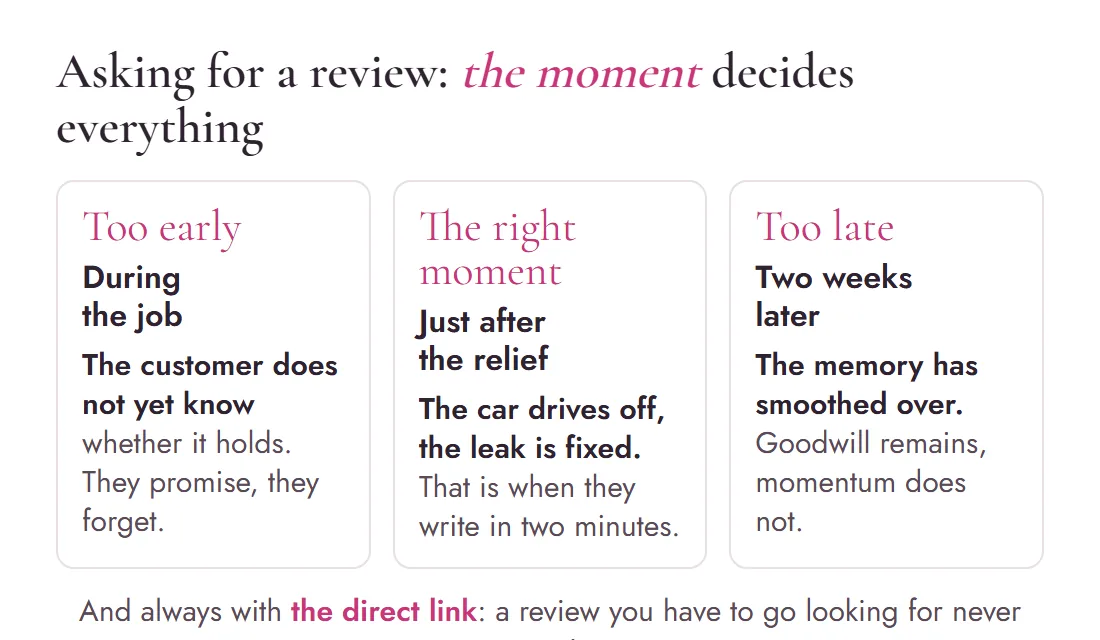
- Pick the right moment. Ask while satisfaction is warm: the car handed back, the website delivered, the stay just ended. The next day is already late; next week is forgotten.
- Ask in person, then send the link. "It would really help if you left a review, I'll text you the link" gives far better results than any automated email.
- Invite detail, without dictating anything. No text to copy, no imposed keywords, no expected rating: a review must reflect a real experience, and ten reviews with the same formula are spotted at a glance. Ask an open question instead: "tell what we did for you and what was useful". A detailed review naturally mentions the service, and often the town, without a single prompted word.
- Make it a routine. Offer it to every customer who genuinely used your service, without cherry-picking: one request a week is about fifty opportunities a year, even if not everyone will leave a review. Regularity outweighs one-off campaigns.
For businesses with walk-in customers, a sign or QR code in the window completes the setup, like on the cover photo: the customer scans while waiting, while the experience is still happening. If you serve international guests, reviews in English are an asset, not a problem: they reassure exactly the customers who search in English.
Answer everything, especially the negative
Answering every review shows future customers their feedback is taken seriously; Google itself recommends replying to reviews. Two sentences are enough for a positive review: a personalised thank-you that names the service delivered.
A negative review is handled in three steps: thank the person for the feedback, give your version calmly and factually, offer to continue in private. You are not writing for the review's author, you are writing for the hundred people who will read the exchange. A composed reply to an unfair review is worth more than a perfect rating: it shows how you handle a problem.
Never reply in the heat of the moment. A draft in the evening, a re-read in the morning, then publish.
A business is not judged on the absence of problems, but on its answer when one appears.
What never to do
- Buying reviews. Fake reviews can be removed, and Google can temporarily block new reviews, hide existing ones or display a public warning on the profile. In France, publishing fake reviews is also a misleading commercial practice under consumer law. And one discovered fake can destroy the trust ten real ones built.
- Offering a discount for a review. Forbidden by Google's rules, even for an honest review. Asking is allowed, rewarding is not.
- Filtering who you ask. Sending the link only to happy customers eventually shows: a profile made only of five-star bursts raises suspicion, Google's and readers' alike.
- Letting relatives "top up". Three reviews from the family are spotted in ten seconds, and they are the first thing your competitors scrutinise.
Showing reviews on your website: the trap we tested for you
Displaying your Google reviews on your own website is a good idea: social proof at the moment of decision. The question is the tool. Free review widgets are a false good idea, and we learned it on our own website.
We had installed a reputable free widget to display our Google reviews. A few weeks later, its free display quota exhausted, the widget replaced our reviews, on the live site, with its own advertising banner: "See our subscription plans". Our customer reviews had become an advert for someone else's software, silently, on every page where the widget sat.
The lesson, valid for everyone: your social proof must not depend on a third party's business model, any more than your domain name and your accounts. The durable solution is a reviews block built into your own site: extracts of genuinely published reviews, reproduced with their authors' consent, the rating with its reading date, a link to your Google profile proving they are genuine, and a "leave a review" link. Updated by hand, two minutes a month, zero dependency. That is what we do now, on our site and on our clients'.
Frequently asked questions
How many reviews do I need before it matters?
There is no official threshold, but the effect is gradual: the first 10 reviews make the profile credible, between 20 and 50 you compete on equal terms with established businesses. Freshness matters as much as volume: one review a month beats thirty at once and then nothing.
Can I ask every customer for a review?
Yes, and it is actually the good practice: ask everyone, without filtering, and without compensation. What is forbidden is paying, rewarding or publishing fake reviews. An honest request after a real service respects Google's rules.
An unhappy customer threatens to leave a negative review, what should I do?
Deal with the real problem first, not the review. If the review lands anyway, reply calmly in three steps: thanks for the feedback, your factual version, an offer of direct contact. A negative review with a professional reply reassures more than a profile with no criticism at all.
Can a fake review be removed?
Yes, if it violates Google's rules: abusive content, conflict of interest, review without a real experience. Report it from your profile, document your request, and reply publicly in the meantime: the reply stays visible even if removal takes time.
Are free review-display widgets reliable?
Caution: several free widgets cap the number of displays and replace your reviews with their own advertising once the quota runs out, as we experienced on our own website. Prefer a reviews block built directly into your pages, with a link to your Google profile as proof of authenticity.
More questions? Many answers are already gathered on our FAQ page.
Do your reviews tell the real quality of your work?
We set up your direct link, your asking routine and the reviews display on your website, with no widget dependency. The first call is free.

Written byMaryna Skachek holds a PhD in biology, is a qualified e-commerce project manager and the founder of MariCleo Studio. She writes about digital strategy, content and the professional uses of AI.