
Page or profile: what each one does, and why the follower count does not tell the whole story

The question comes up at almost every first meeting, nearly word for word: "our page has very few followers, are we doing something wrong?". No. A company page often recruits followers less easily than a personal profile, notably on Facebook and LinkedIn, and that is not the point. The point is what a hesitating customer finds when they come to check. If they land on three posts in a year, they leave with a doubt they did not have when they arrived.
What the counter no longer decides
For years, the number of followers served as the measure of success because it was the only one visible. That is no longer how networks distribute what you publish. Adam Mosseri, who runs Instagram, has described the mechanism publicly: a public post is first shown to a small group of people, including non-followers, and if it holds that first group's attention, it is offered to a larger group, then a larger one still. A logic of progressive testing, in short. A small account can therefore reach people who do not follow it yet. Not automatically, and not in the same proportions as an established account, but the number of followers no longer closes the door to recommendation on its own.
The signals he named, in a statement on 22 January 2025 that remains the reference: time spent on the post, likes, and shares by private message. With a useful nuance for understanding what happens to you: likes weigh mostly on distribution to your followers, shares weigh mostly on recommendation to strangers. He also said, against ten years of advice, that hashtags do not improve reach. They remain useful for context and search, not as an automatic lever for distribution.
Keep the consequence, it is liberating: what you publish can leave your circle without your circle being large. What helps it leave its circle is someone reading to the end and sending it to a person it speaks to.
One clarification before going further: Instagram speaks of a professional account, while Facebook and LinkedIn genuinely distinguish the personal profile from the company page. The signals cited here concern Instagram. They illustrate a general shift towards recommendation, but platforms do not all distribute posts the same way.
Profile and page do not do the same job
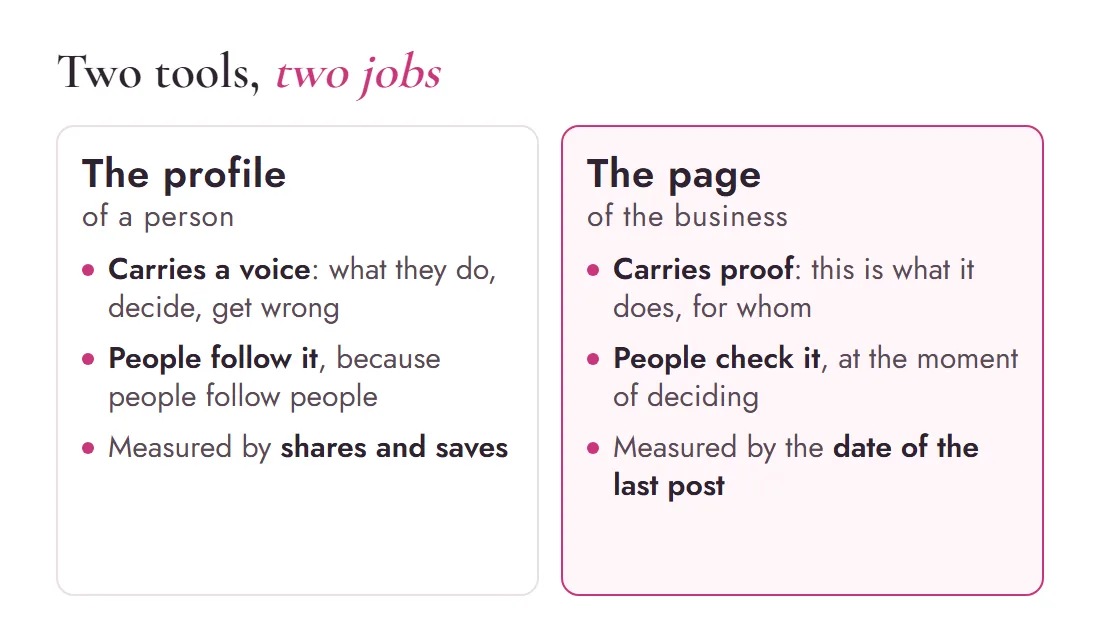
The second mistake is to put them in competition. A personal profile carries a voice: someone tells what they do, what they decide, what they got wrong. People follow people. A page carries proof: here is what this business does, for whom, with what results, and here is evidence that it is alive. People do not follow proof, they consult it. At the moment of choosing.
That is why the page's counter stays modest and why it is not a failure. For many small businesses, the page's first job is not to gather a large audience: it is to be found, and to reassure at the moment of decision. Its audience is not a follower, it is a buyer mid-decision who types the company name to have a look. They look at three things: is the latest post recent, does the business talk about what I am looking for, are there real faces and places or only stock images. And often, right after, what customers say about it.
An empty page answers no to all three. It says "this business may no longer be active", while you work every day. A page that publishes regularly, even without a single comment, answers yes to all three. The apparent silence is not a problem: the customer who comes to check may leave without a single visible interaction, then call.
A recent page is not enough if the next step stays invisible. The description must say what the business does, for whom and in which area. The link, the number or the contact button must be reachable at once. A page must not only reassure: it must let people act, exactly like a landing page.
What to watch before the number of followers
If the counter no longer decides, something else has to be read, and those other things exist in each network's native statistics, free of charge. In the order in which they move:
- The share of followers and non-followers in your reach. That is what shows whether a post really leaves your existing audience. Native statistics show it for each post; reach above the follower count proves nothing on its own.
- Shares and saves, counted separately from likes. Saves are not among the three signals Mosseri named, but they say interest. A like costs nothing. A save rather says "I'll come back". A send by private message says "this is about you", and it is the best indicator of distribution to non-followers.
- Profile visits and clicks to the website, because they look like the beginning of a customer. Someone who read a post and went to see who you are is closer to calling than ten people who liked it.
- The first qualified interaction from a stranger: a message, an enquiry, a comment that says something. It is not in the statistics, and it counts more than they do. Note it, with the date.
The number of followers comes next. It may grow if the other indicators move, but it is neither the first signal to read nor the main goal of every page. Reading it first is reading the conclusion before the story.
Choosing where to invest your effort, when you cannot be everywhere
Being present everywhere is being weak everywhere. The right question is not how many networks, but which one first, and the answer depends neither on fashion nor on your age. It depends on how your customers decide. As a starting point, to be checked against your own customer journey:
- If your customer chooses you after seeing your work, you need image, and real photos: Instagram.
- If they choose you on local recommendation, you need proximity: Facebook, and the groups of your area.
- If they have to justify their choice to someone else, a partner, an accountant, a board, you need written credibility: LinkedIn.
- If they look for you at the precise moment they have the problem, you need Google, the listing and the pages, before everything else.
For some local trades, searched for at the moment of an urgent need, Google comes before social networks, and many still exhaust themselves on the other three. One network kept up beats four abandoned, and the second gets added when the first runs without effort.

The rhythm that holds, rather than the one that impresses
A page does not fill up in one week of catching up, and it does not need to. What the checking customer looks at is the date of the last post and the regularity of the previous ones. One or two useful posts a week, kept up over time, can be enough to keep a credible presence, if the goal is not fast audience growth. Thirty posts in a month followed by silence do the opposite: they date the abandonment. Write cold, with a month's lead in a spreadsheet, and choose a rhythm the business can actually keep. Regularity does not guarantee reach. Above all, it keeps the page from looking abandoned.
Frequently asked questions
Should we post on the owner's profile or on the company page?
Both, with different roles. The profile carries a voice and recruits followers, because people follow people. The page carries the proof that the business is alive and does what it says; nobody follows it, they consult it at the moment of choosing. Posting only on the profile leaves the page empty, and the page is what the hesitating customer types.
Can a page with very few followers really be seen?
Yes. Adam Mosseri, who runs Instagram, has described a logic of progressive testing: content eligible for recommendations may first be shown to a small group, followers or not, and its distribution may then widen if it draws good signals. What counts is the behaviour of the first viewers, in particular time spent and shares by private message, not the account's follower count.
Do hashtags still help?
According to Adam Mosseri himself, no: they do not improve reach. They remain useful for context and search, not as an automatic lever for distribution. Time spent on the post and shares weigh more than any hashtag.
Which indicator should we follow when starting an account?
The share of non-followers in each post's reach: that is what shows whether the content leaves your existing audience. Then shares and saves, counted separately from likes, and profile visits. The number of followers comes next, and it is not the goal of every page.
More questions? Many answers are already gathered on our FAQ page.
Want a page that reassures when a customer comes to check?
We build the rhythm, the topics and the visuals for one network at a time, the one where your customers decide, and we read each month the indicators that move before the counter. You leave with a month of topics, a realistic rhythm and a dashboard limited to the indicators that actually matter.
Information current as of 4 September 2026. Main sources: public statements by Adam Mosseri, head of Instagram, post of 22 January 2025 on the three ranking signals (watch time, likes and sends by private message, the last two measured against reach), reported the same day by Social Media Today, and statements on hashtags. The signals cited concern Instagram; Facebook and LinkedIn do not publish the same detail. The figures circulating on the relative weight of a share versus a like have no identified source and are not repeated here. Cover photo: Jan van der Wolf, Pexels.

Written byMaryna Skachek holds a PhD in biology, is a qualified e-commerce project manager and the founder of MariCleo Studio. She writes about digital strategy, content and the professional uses of AI.
Be found, then checked
Social media
One network at a time, a rhythm that holds, and a monthly reading of the right indicators.
See the service →Google reviews
The other place where the hesitating customer comes to check, and how to reply there.
Read the article →The Google listing, full guide
For many local businesses, the only network that is truly necessary.
Read the guide →