
Website accessibility: who is really concerned, and why do it anyway

For a year now, tradespeople and shopkeepers in France have been receiving emails that open with a fine and close with a quote for an audit. The amounts vary from one sender to the next, which should already raise an eyebrow. This article will not tell you that you risk nothing, nor that you risk everything. It is the same exercise as for the "AI-generated" label: read the text before you read the quote. It shows you the two texts that actually exist, their thresholds, where to read them, and the half of the story those emails leave out: a site readable by a partially sighted person is also a site readable by your sixty-year-old customer, outside, in full sunlight. That one, you are already losing.
What "accessible" means, in practice
An accessible site is one that can be used by a person who cannot see, who sees poorly, who cannot hear, who cannot handle a mouse, or who needs clear, structured information. Put that way, it sounds distant. Look at what it demands in practice and you will see it is everyday work: text with enough contrast against its background; images described in words in the code, so a screen reader can say them; form fields that carry a label, not only a grey hint that vanishes when you type; buttons big enough for a thumb; navigation possible with the keyboard alone; subtitles on videos. None of this is high technology. It is mostly missing because nobody asked for it.
The first text: the 2005 law and the RGAA
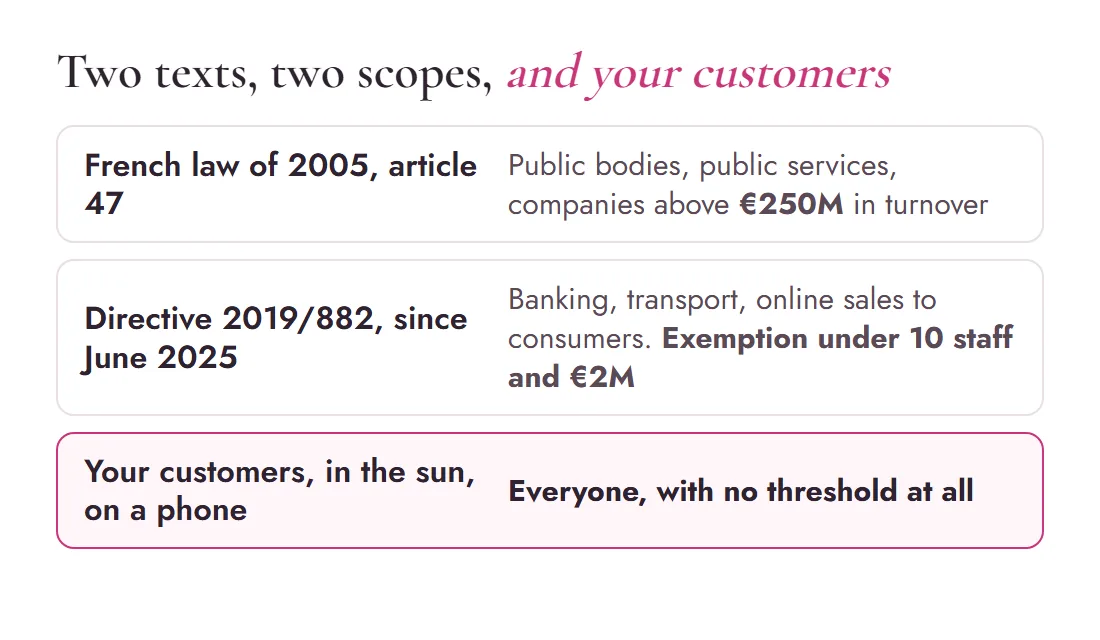
In France, the oldest digital accessibility obligation comes from article 47 of law no. 2005-102 of 11 February 2005. The State's official site, accessibilite.numerique.gouv.fr, details its scope: public bodies, organisations entrusted with a public service mission, and private companies whose annual turnover, averaged over three years, exceeds 250 million euros. The technical standard is called the RGAA, built on the European norm EN 301 549; a version 5 of the RGAA is announced for late 2026.
Keep the threshold in mind. An ordinary small business does not generally fall within that scope merely because it has a website, and no sales email can put it there.
The second text: the 2019 European directive, in force since June 2025
This is the text that triggered the wave of emails, and it deserves to be read for what it says. European directive 2019/882, transposed into the French consumer code, has applied since 28 June 2025 to a precise list of products and services aimed at consumers. The reference numbers of the texts are in the sources at the bottom of the page.
It targets specific products and services aimed at consumers: banking services, passenger transport, electronic communications, e-books, and, among the services listed in article D. 412-50, e-commerce. In other words, an online shop selling to private individuals falls within the perimeter; a tradesperson's brochure site that presents the business and gives a phone number does not fall in on the same basis.
And the text provides an exemption for microenterprises, defined as employing fewer than ten people with a turnover or balance sheet not exceeding two million euros. Here, "microenterprise" is a size category in the European sense, not the French micro-entrepreneur tax status. Under this regime, no accessibility obligation applies to microenterprises that provide services.
What we will not tell you
We will not tell you the amount of the fine you risk, because it depends on what you sell, and to whom. Here is what the texts say instead, and the amounts are not all invented: they belong to different regimes. For the first text, article 47-1 of the 2005 law, created in 2023, gives enforcement to Arcom, the French audiovisual and digital regulator, which can impose, after a formal notice, a penalty of up to 50,000 euros for failing the accessibility requirements, and 25,000 euros for the other obligations, such as the accessibility statement; this covers the bodies subject to article 47, and for private companies above the threshold Arcom only checks the display obligations. For the second text, the DGCCRF, the French consumer protection authority, states in its guidance for professionals that breaches of the accessibility obligations in the consumer code are fifth-class offences, 7,500 euros, cumulative by the number of breaches found, for the services listed in the consumer code and provided by businesses that are not exempt. The "3,000 euros a day" exists too, in another form: an order to bring a service into compliance can carry a daily penalty of up to 3,000 euros, capped at 300,000 euros, according to the Mon Parcours Handicap portal. None of these sums is triggered automatically by an audit score: first there is a regime, an authority, a procedure. The right question is therefore not only "how much?" but "which text actually applies to my business, and under which procedure?". If a provider announces an amount, ask for the article, the Légifrance page and the scope: the answer will tell you everything you need to know about the provider.
A recent fact helps put the emails in their place. Since January 2026, the DGCCRF has been investigating both the accessibility of e-commerce websites and apps and the fairness of the practices of organisations selling digital accessibility audits, according to its review of 25 June 2026. In other words, it looks at the websites, and also at those who sell fear around the websites.
Nor will we tell you that you are in the clear. This article is not legal advice, and two cases deserve a proper check with your accountant or adviser: if you sell online to private individuals, and if you work as a supplier to a local authority or public body, whose specifications may require accessibility even where the law does not oblige you directly. The DGCCRF is one of the competent authorities for the second text, notably for e-commerce; its site is the right source, not an agency blog.
The half the emails leave out
Here is what really matters, and what depends on no threshold. Take the list from the start again: contrast, described images, form labels, buttons big enough, navigation without a mouse, subtitles. Now describe your customer. He is sixty, he is in the car park, the sun is beating on the screen, he is looking for your number because his boiler has just died. The light grey text on white that looked lovely on the designer's screen, he does not read. The "call" button the size of a lentil, he misses. The form whose label disappears as soon as he starts typing, he no longer knows which field he is filling in. He closes it, and calls the next one.
Accessibility is not a standard for other people. It is the difference between a page that reads in your customers' real conditions and a page that reads in the conditions of the office where it was made. A more accessible site puts fewer needless obstacles between the customer and the action. And the customer who hits an obstacle will never tell you why they left.

Three fixes that cost almost nothing
- Contrast. Body text in a frank dark colour on a light background, not medium grey. The designer's elegant grey is the first thing to vanish in sunlight. Free tools measure the contrast ratio of a pair of colours; the common reference asks for at least 4.5 for normal text.
- Target size. Everything that gets tapped, buttons, links, the phone number, must be tappable with a thumb, without aiming. Count generously, and leave air between two clickable elements.
- Image descriptions. Every photo that carries meaning gets a written description in the code. It is read by screen readers, and it also helps Google understand the subject and context of the image. Here, accessibility and search often meet.
A fourth, slightly longer: that each form field has a visible, permanent label, and that the error message says which field to correct. That can reduce abandoned forms.
The full-sunlight test
It requires no tool. Go outside with your phone, at noon, open your site, hold the device at arm's length, and try to do what a customer would do: find the number, understand what you do, send an enquiry. They are the same gestures as in the seven signs of a website that brings no clients, seen in sunlight. Time it, and note every place where you squinted or missed a button. Then have someone older than you do it. The list that comes out is worth more than an automatic score, because it describes your customers and not a grid.
This test checks neither keyboard navigation, nor screen readers, nor conformance with a standard. It complements an audit, it does not replace it.
A word on those automatic scores, since the emails often wave one around: a tool that marks your site out of 100 measures what a program can measure, the existence of an image description, not its accuracy; the presence of a label, not its clarity. A high score is not conformity, and a low score is not a conviction. It shows where to look, it does not replace the look.
Frequently asked questions
Is my tradesperson's brochure site required to be accessible?
Not under the two main texts as they are written. Article 47 of the 2005 law targets public bodies and companies above 250 million euros in turnover. The 2019 European directive, in force since 28 June 2025, targets specific consumer services, including e-commerce, with an exemption for microenterprises. A brochure site that does not sell online is not on those lists. This article is not legal advice: if you sell online or work for a public body, check your case with your adviser.
What is the amount of the fine?
Two amounts exist, in two different regimes. Article 47-1 of the 2005 law lets Arcom impose, after a formal notice, a penalty of up to 50,000 euros on the bodies subject to article 47: public bodies, delegated public services and, for display obligations only, companies above 250 million euros. For the services in the consumer code, the DGCCRF mentions 7,500 euro offences, cumulative by the breaches found. The "3,000 euros a day" is a daily penalty that can accompany a compliance order, capped at 300,000 euros, not an automatic fine. A tradesperson's brochure site falls under neither regime merely because it exists. Ask anyone who announces an amount for the article, the Légifrance page and the scope.
Does an accessibility score of 95 out of 100 mean my site is compliant?
No. An automatic tool measures what a program can measure: the presence of an image description, not its accuracy; the existence of a form label, not its clarity. The score shows where to look. Conformity in the RGAA sense is established by a human audit against the standard, and real usefulness is established by trying the site in your customers' conditions.
Does accessibility help search rankings?
Partly, and with no promise of position. Describing images in words, structuring headings, giving forms labels and readable text are gestures Google reads too. They are the same gestures, not a separate bonus. What helps above all is that a site readable in real conditions loses fewer visitors before the enquiry.
More questions? Many answers are already gathered on our FAQ page.
Want to know what your site looks like in full sunlight, without an alarmist email?
We look at contrast, targets, images and forms in your customers' real conditions, and we tell you in writing what is worth fixing, and what is not.
Information current as of 4 September 2026. This article is general information, not legal advice. Main sources: accessibilite.numerique.gouv.fr, scope of article 47 of law no. 2005-102 · directive (EU) 2019/882 · law no. 2023-171 of 9 March 2023, article 16 · consumer code, articles D. 412-49 to D. 412-62 · DGCCRF, guidance for professionals · Mon Parcours Handicap, EAA entry into force (30 June 2025, daily penalty) (13 November 2025, updated 1 December 2025) and one-year review (25 June 2026) · ordinance no. 2023-859 of 6 September 2023 · decree no. 2023-931 of 9 October 2023, Légifrance · Valentin Haüy association, reference texts on the accessibility of products and services. Cover photo: Gustavo Fring, Pexels.

Written byMaryna Skachek holds a PhD in biology, is a qualified e-commerce project manager and the founder of MariCleo Studio. She writes about digital strategy, content and the professional uses of AI.
A site that reads in real conditions
The guide to a site that finds clients
Structure, content, measurement: what we check on every site before touching it.
Read the guide →AI Act: do you have to label?
The other European text sold to you with fear, read article by article.
Read the article →Showcase or e-commerce site
Contrast, targets, forms: readability is part of the brief, not an option.
See the service →