
Do you have to label AI-generated content? Five situations, five verdicts

Since 2 August 2026, the same question keeps coming up among business owners, and not only French ones: the EU AI Act applies to anyone offering products or services on the European market. "Apparently everything made with AI now has to be flagged. A post edited with ChatGPT, do I need to label it?" Short answer: no. The worry comes from two confusions, and a lot of the content in circulation keeps them alive. This article takes them apart one by one, then runs five real situations through the regulation, sources included.
The two confusions behind the fear
First confusion: the roles. Article 50 of the AI Act does not place the same obligations on the provider of the system, such as Anthropic, OpenAI or Google, and on the deployer, which in most cases means the business using the tool. Most of the technical obligations sit with the provider. Some of the fears being sold to you are duties that are not yours.
Second confusion: invisible marking versus a visible label. Machine-readable marking, embedded in the content or in a file's metadata, is mainly the provider's job. The visible label, the one meant for the public, concerns the deployer only in specific cases. Two mechanisms, two responsibilities, and one big mix-up in many of the commentaries.
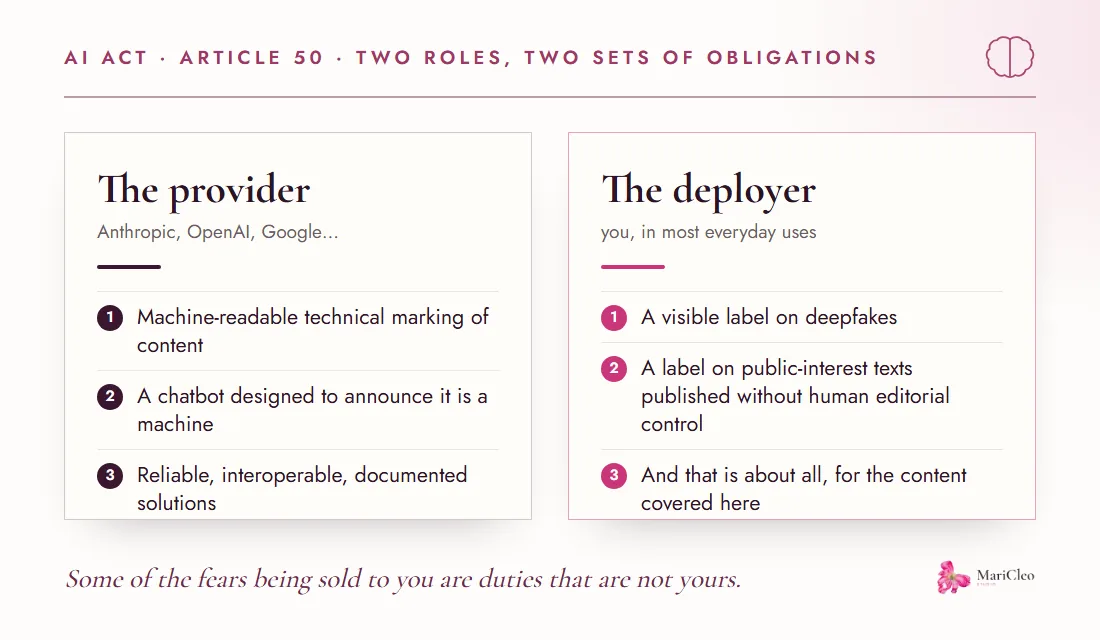
The short version, before the detail. Every line is unpacked further down.
| Situation | Visible label? | Who has to act? |
|---|---|---|
| Chatbot on your website | Visitors must know they are talking to a machine, unless it is obvious | The provider builds it in; you check that it works |
| Post edited or restructured with AI | No, where genuine human editorial control exists | You document who validates what |
| Deepfake | Yes, from the public's first exposure | The deployer distributing the content |
| Public-interest text published without human control | Yes | The deployer publishing it |
| Fully synthetic image in advertising | Not automatically | The provider handles technical marking; the message stays yours |
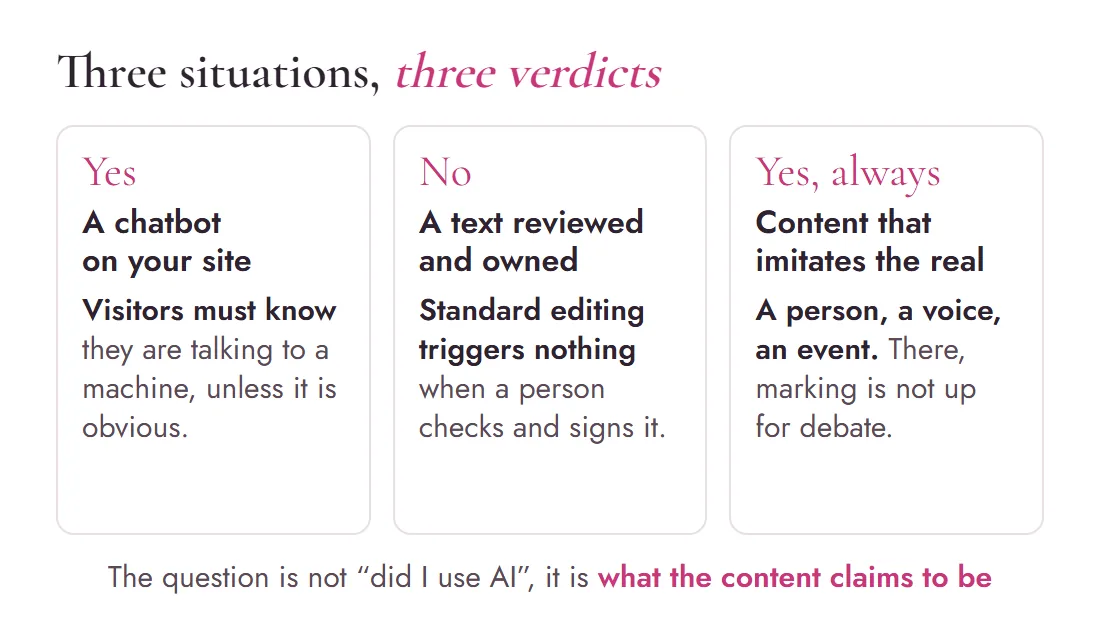
Situation 1. You have a chatbot on your website
Visitors must know they are talking to a machine, unless that is obvious from the context. It is the provider's job to design the system so this information appears from the start of the conversation.
Your job is to check that it actually does, and to resist the temptation of a fake adviser with a first name and a photograph suggesting a real person. On this site, the assistant is called Cléo. She says what she is, and nobody is worse off for it.
Verdict: the chatbot clearly presents itself as an AI.
Situation 2. You publish a post edited or restructured with AI
You write. The tool fixes the grammar, tightens the sentences or suggests a better order. Is a label required?
No, not for that reason alone.
Article 50 does not sweep up every piece of marketing text. The visible-labelling obligation targets texts published to inform the public on a matter of public interest, when they have not gone through genuine human review with editorial responsibility attached. Standard editing is also among the situations that can be excluded from the technical-marking obligation placed on the provider.
Checking only the spelling is not necessarily substantial editorial control. Verifying the facts, weighing the arguments, changing the substance and putting your name to the result: that is. The same reflex applies to the other European text feeding scare emails this year, the web accessibility law: read the scope before the amount.
Verdict: a text genuinely reviewed and owned by a person does not get a visible label simply because an AI helped write it.
Situation 3. You distribute a deepfake
A real person appears to say something they never said. An existing place, object or event is shown in a realistic but false way.
Here the visible label is mandatory from the public's first exposure to the content. A hidden metadata tag is not enough: the information must be understandable without any special tool. Humour, satire and fiction are entitled to an adapted presentation so the disclosure does not destroy the experience of the work, not to a quiet disappearance of the transparency obligation.
Verdict: visible disclosure. For a marketer, this is not a principle to play hide-and-seek with.
Situation 4. You publish automatically generated public-interest information
A text about health, the economy, consumer safety or the environment is generated and then published with no substantive validation: the artificial nature of the content must be disclosed.
With genuine human editorial control, the labelling obligation falls away. The test is not "a human clicked approve". The test is: a competent person was able to check, accept, amend or reject the substance of the text, and takes responsibility for it.
Verdict: the label answers the absence of editorial control, not the mere use of the tool.
Situation 5. You use a generated image in your advertising
A fully synthetic image that does not claim to authentically depict an existing person, object, place, entity or event is not automatically a deepfake. Article 50 therefore does not require you, on that ground alone, to add a visible "AI-generated" banner. Technical marking of the content or file sits with the provider.
Your responsibility stays intact on something else. If the image deceptively simulates a real person or an existing situation, it can fall into the deepfake category. A fake testimonial or a misleading staging can also breach advertising rules, even when it does not legally qualify as a deepfake.
Verdict: technical marking is mainly the provider's job. The message and the advertising promise remain yours.

The date everyone quotes wrong
Article 50 has applied since 2 August 2026.
The extra time until 2 December 2026, introduced by the AI Omnibus, covers one obligation only: the machine-readable marking under Article 50(2), for systems already on the market before 2 August. It is not a general postponement of the transparency obligations. It is a limited transition period for a technical duty which, when you are a simple deployer, does not usually fall on you directly.
What the Claude watermark actually proves
On 14 August, Anthropic explained how the watermark for texts produced by Claude works.
This does not mean every text generated today by every Claude model is already marked. New models launched in the European Union from 2 August onwards must support marking from launch. For older models, Anthropic says the rollout is still in progress.
Where the mechanism is supported, Claude introduces an imperceptible pattern into its word choices. The pattern travels with the text through copy-paste and can survive some light editing. For compatible formats, files such as PNG, JPG or SVG images can carry provenance metadata signed to the C2PA standard.
And here is what almost everyone misses.
Anthropic writes it in black and white: the mark means only that the content was probably processed by Claude. Not that Claude is its author.
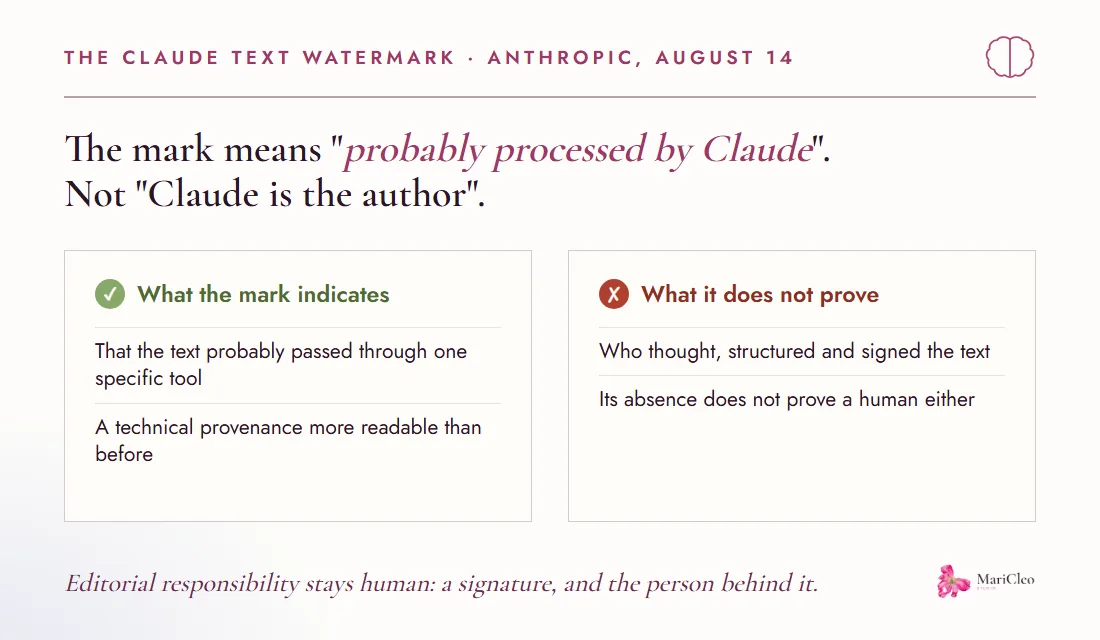
Your text, your ideas, your first draft, then a translation or a polish by the tool: the result can carry the mark. A text generated by an older model, too short, or rewritten enough may, conversely, carry no detectable mark at all. The absence of a watermark does not prove a human. Its presence does not prove a machine author.
So who comes out of this weakened? Not authors' anonymity. The reflex: "I'll run your text through an AI detector and I'll know who wrote it." The watermark gives more solid information about the probable involvement of one specific provider. It still gives no binary answer to the question of authorship.
Technical provenance becomes more readable. Editorial responsibility stays human: a signature, and the person who stands behind it.
Where to start, in practice
- Clarify your role. You are a deployer in the vast majority of ordinary uses. You can become a provider if you develop, or have developed, a system that you market or put into service under your own name; a substantial modification can also require a fresh look at your status.
- Have your chatbot say what it is, in plain words.
- Document who validates what: a name and a responsibility per content type, not just a click.
- Plan visible labelling for deepfakes and for public-interest texts published without human editorial control. Article 50 also covers other uses, notably emotion recognition and certain forms of biometric categorisation.
- Keep the provenance information your tools produce. It does not replace your responsibility, but it can make your process easier to trace.
Five free resources worth keeping to hand
Nothing sponsored, no card required for the use described here.
Check, trace, state
- The official AI Act compliance checker, run by the European Commission's AI Act Service Desk, still in beta: it helps identify which rules are likely to apply to your system and your role. A starting point, not legal advice.
- Content Credentials Verify, the Content Authenticity Initiative's tool. Drop in an image and it shows any C2PA provenance metadata. Useful both ways: checking what your own exports say about you, and examining a visual received from a supplier.
- An editorial log in three columns: content, who validated the substance, date. A spreadsheet is enough. It is an operational trace of your validation process: not legal proof on its own, but it documents who validated what and when.
- Anthropic's documentation on content marking and the watermark explainer: read them once in full rather than ten summaries of summaries.
- One plain-language editorial policy sentence on your website, along the lines of: "Our content is designed, checked and signed by identified people. AI tools may assist at various stages: preparation, drafting, review or translation; editorial validation remains human." Rarely a legal obligation. Always a commercial argument, and one awkward conversation fewer when a client asks the question.
The transparency this regulation asks for is not a confession to stick under every creation. It is the ability to answer three simple questions: who checked? Who decided? Who signs? In your business, do those questions already have an answer, or does everything still rest on the "publish" button?
Frequently asked questions
Do I have to label a post edited or translated with ChatGPT?
No, not for that reason alone. The visible-labelling obligation in Article 50 targets public-interest information published without genuine human editorial control, and deepfakes. A text you thought through, checked and signed does not become labellable because a tool fixed the grammar or tightened the sentences.
Who does Article 50 apply to: the AI company or the business using the tool?
Both, but not for the same things. The provider (Anthropic, OpenAI, Google…) carries most of the technical obligations: machine-readable marking, a chatbot designed to present itself as a machine. The deployer, meaning the business using the tool, owes a visible label only in specific cases, such as deepfakes.
Does an AI-generated image in an advert need an "AI-generated" banner?
Not automatically. A fully synthetic image that does not claim to authentically depict an existing person, place or event is not a deepfake under the regulation. Technical marking of the file sits with the provider. A misleading staging, however, can breach ordinary advertising rules regardless of the AI Act.
What does the postponement to 2 December 2026 change?
Much less than the commentary suggests. That extension, introduced by the AI Omnibus, covers only the machine-readable marking under Article 50(2), for systems already on the market before 2 August 2026. The other transparency obligations have applied since 2 August. It is not a general postponement.
Can the Claude watermark prove a text was written by an AI?
No. Anthropic states it explicitly: the mark means the content was probably processed by Claude, not that Claude is its author. A human text polished by the tool can carry the mark; a generated text rewritten enough may not. The absence of a watermark does not prove a human, and its presence does not prove a machine author.
Does the EU AI Act apply to my business if I am not based in the EU?
It can. The regulation applies to providers and deployers whose AI systems or content reach people in the European Union, wherever the business is established. If you sell to EU customers or publish for an EU audience, the transparency rules described here are worth reading as if they were yours.
More questions? Many answers are already gathered on our FAQ page.
Want to use AI without losing your clients' trust?
A chatbot that introduces itself honestly, signed content, a documented validation process: that is exactly how we build ours. Let's talk about your situation.
This article offers an operational reading of the AI Act's transparency rules and is not legal advice. Information current as of 20 August 2026; the guidelines and the AI Omnibus timetable may evolve. Main sources: Regulation (EU) 2024/1689, notably Article 50 · the European Commission guidelines on transparency obligations, published 20 July 2026 and updated 6 August 2026 · the code of practice on the transparency of AI-generated content, final version of 10 June 2026 · the Commission FAQ on Article 50 · Anthropic, "How Claude marks AI-generated content" and "How Claude's text watermark works", 14 August 2026. Cover photo: Mikhail Nilov, Pexels.

Written byMaryna Skachek holds a PhD in biology, is a qualified e-commerce project manager and the founder of MariCleo Studio. She writes about digital strategy, content and the professional uses of AI.