
What Google changed and how to measure it: the small-business guide

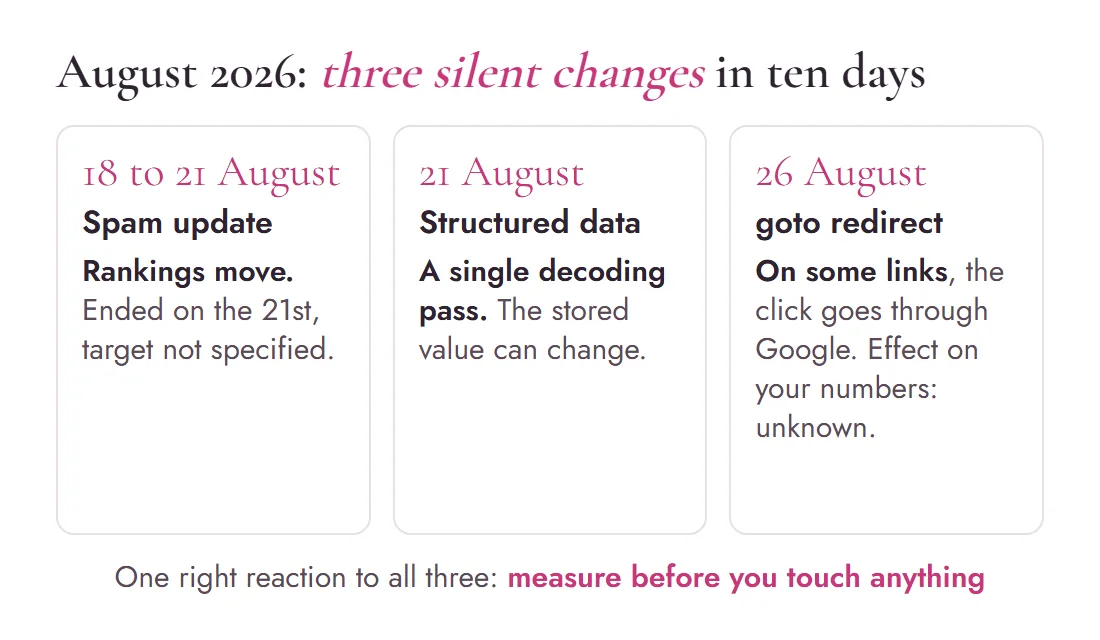
Between 18 and 27 August 2026, Google changed three things: how it ranks websites, how it reads their code, and the path a visitor travels between the search results and your page. None of these changes appeared on any screen. None sent a notification. Yet each one can move your numbers, or make them look as if they moved, which is not the same thing. This guide explains how to tell the difference, with a method that fits into four steps and needs no paid tools.
Three changes in ten days, and why nobody saw them
On 18 August, Google rolled out an update to its spam system, completed on the 21st, worldwide, in every language. The company did not specify what the update targets, and said nothing about AI-generated content, contrary to what many commentators claimed. After this kind of update, some sites rise, some fall, and panicked owners rewrite pages that asked for nothing. If your traffic has moved since, start with our five-check protocol: Your Google traffic dropped: five checks before you touch anything.
On 21 August, a quieter change still: Google stopped fixing certain encoding errors in structured data on your behalf, the invisible block of code that tells it "this is a price, this is a rating, this is the company name". The error triggers no alert, the validation test can stay green, and the recorded value changes in silence. The full verification walkthrough is here: Structured data: why the green light is no longer enough.
On 26 August, Google confirmed the rollout of a redirect between its results and websites: a visitor who clicks now passes through an intermediate Google address before reaching you. Its effect on your analytics: unknown at the time of writing, and that uncertainty is managed precisely by measuring. The details: google.com/goto: the invisible door between Google and your site.
Three different natures: a ranking, a code reading, a click path. One thing in common: none of the three can be repaired blind. That common trait is what justifies a guide.
The expensive reflex: repairing before measuring
When numbers fall, instinct pushes you to act. Rewrite pages, change providers, accept the cold call promising to "recover your rankings" for a subscription. That instinct is wrong twice over. First because a late-August drop can come from the update, but also from the end of the holidays, from your customers' own calendar, or from a change you made to the site yourself: two bad weeks prove nothing. Second because a repair launched without a diagnosis destroys the one thing that would have allowed you to understand: the reference state. If you rewrite ten pages while rankings are moving, nobody will ever know what produced what.
My previous profession, scientific research, has a name for this discipline: controlling the variables. You fix a baseline, you change one thing at a time, you never conclude from a single data point. None of it requires a laboratory. A notebook is enough.
The method: four steps, no paid tools
1. Set your baseline, today
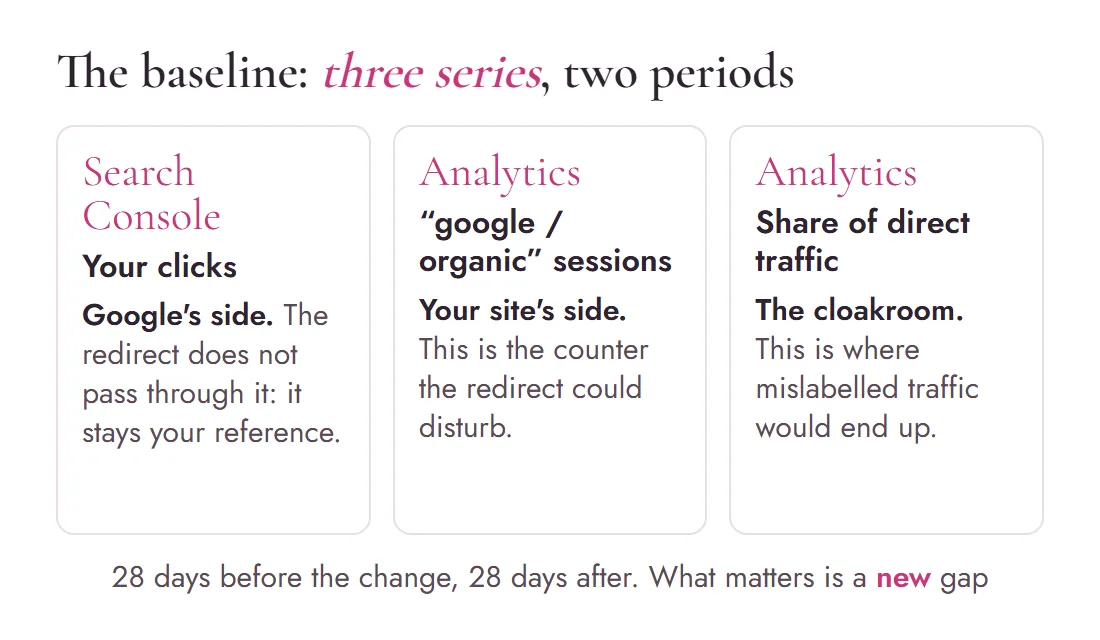
A baseline is the state of your numbers before anything is touched, dated and kept outside the tool that displays them. Without it, "it dropped" and "it's recovering" are moods. With it, they are measurements. Three series are enough for a small-business website: your clicks in Search Console, your "google / organic" sessions in GA4 or whichever analytics tool you use, and your share of direct traffic. Note all three, with the date. A dated screenshot does the job perfectly.
The baseline in practice, twenty minutes
- Search Console, Performance report: clicks and impressions over the last 28 days. Note both totals and the date.
- Your analytics tool: sessions from "google / organic", sessions marked "direct", total sessions, over the same period.
- Your real enquiries: calls, forms, quote requests for the month. This is the number that pays the bills; it belongs in the baseline as much as the others.
- Your five vital search queries: type them into Google and note what appears above your site, including whether an AI Overview shows. It is a snapshot, the display varies by place and moment: date it.
- Store everything outside the tool: notebook, spreadsheet, document. Interfaces change, default periods change; your note does not.
2. Keep the change log
The notebook's second column: what changed, and when. Your own changes first, because they explain more traffic drops than Google does: a redesign, a migration, ten deleted pages, a new theme, a caching plugin. Then dated external events: an update announced on Google's official status dashboard, a press article that mentions you, an advertising campaign. When a curve moves, this log turns the question "why?" into a simple lookup: what happened that week, at your end or outside?
3. Read the numbers together, never separately
This is the step almost nobody takes, and it is the most powerful of the four. Each tool measures something different: Search Console counts clicks on Google's side, your analytics tool counts arrivals on your site's side. As long as both tell the same story, the variation is probably real. When they diverge, you are holding a signal of a different nature.
A concrete example with August's redirect: if one day Search Console stays flat while your analytics loses "google / organic" traffic to "direct", demand has not fallen, the origin label has shifted. That is not yet a cause, it is a signal worth investigating, and it is already far more than a shiver. The reverse is instructive too: clicks falling in Search Console at equal positions, while your pages stay well ranked, point to a change in how results are displayed rather than to a problem with your site.
4. Decide on four weeks, not on two days
Google's documentation is explicit: its spam systems are re-evaluated periodically, without an announcement each time. Rankings can therefore move again after an update, in either direction. Add seasonality, the back-to-school period, the weather of your own trade, and the conclusion writes itself: a decision made on two days of data is a bet, a decision made on four weeks is an informed choice. Set in advance the date on which you will reopen the notebook, and keep it. That future appointment is also your best protection against the urge to touch everything in between.
When to act immediately, all the same
Measuring first does not mean never doing anything. Three situations justify immediate action, because the diagnosis there is certain. A manual action shown in Search Console: that is not an algorithm effect, it is a notified sanction, and it gets handled. A wrong value in your structured data, confirmed in the official test: your company name or a price recorded incorrectly will not fix itself, and the check takes two minutes. A compromised site, pages added without your knowledge or redirects you never created: every day counts. In every other case, measurement comes first.
What this guide does not claim
Nobody knows the detail of Google's algorithm, and this guide does not pretend to. Nor does it promise that good measurement lifts a site's rankings: it does something better, it tells you whether the problem exists, where it lives, and whether the money you are about to spend has a target. The first published figures on AI Overviews in France illustrate the nuance: the Ahrefs study of August 2026, run on 963 high-traffic domains, measures a 23.1% drop in click-through rate for the most exposed sites, over a nine-day window, at the height of summer, published by an SEO tool vendor. That is a serious first signal, not a verdict, and above all it is not YOUR number: your own exposure takes ten minutes to check with your five vital queries. The general measurement informs; only yours decides.
Three questions close this guide, the same three that open every diagnosis we run: what do your numbers say, since when, and compared to what? The day those three answers fit on one page of a notebook, nobody can sell you a panic again.
Frequently asked questions
My traffic dropped after a Google update: should I rewrite my pages?
Not before you have dated the drop, separated brand searches from the rest, checked for manual actions in Search Console, listed your own changes for the month and compared with the same period last year. Those five checks take an hour and prevent most pointless rewrites. If the drop is still unexplained afterwards, then the substance gets examined, calmly.
Which numbers should I note for a useful baseline?
Three series are enough: Search Console clicks and impressions over 28 days, "google / organic" sessions and the share of direct traffic in your analytics tool, and your real enquiries for the month, calls and forms. Note them with the date, outside the tool, in a notebook or spreadsheet. Twenty minutes, no paid tools.
Search Console and my analytics disagree: which one should I trust?
Both: they do not measure the same thing. Search Console counts clicks on Google's side, your analytics tool counts arrivals on your site's side. Their divergence is information in itself: flat on one side and falling on the other, it points to a measurement or labelling issue rather than a real loss of visitors.
How long should I wait before concluding that a change affected me?
Four weeks of data, compared with the same period of the previous year when your business is seasonal. Google re-evaluates its systems periodically without announcing it, and rankings can move again after an update. Two bad days prove nothing; a documented month does.
Do I need a paid SEO tool to apply this method?
No. Everything this guide describes relies on Search Console and on the analytics tool your site already has, both free, plus a notebook or spreadsheet. Paid tools have their place for going further, but the baseline, the log and the cross-reading need none of them.
More questions? Many answers are already gathered on our FAQ page.
Your numbers are moving and you want a calm diagnosis?
Baseline, cross-reading of the tools, written verdict: that is exactly how we examine a website before recommending anything, in French or in English. Tell us what you are seeing.
Information current as of 27 August 2026; the dates and rollout status of the changes described may evolve. Main sources: Google Search Status Dashboard, spam update of 18 to 21 August 2026 · Google Search Central announcement of 21 August 2026 on structured data processing · Google's confirmation of the click redirect, 26 August 2026 · Ahrefs, study of the click drop linked to AI Overviews in France, August 2026, 963 domains, aggregated Search Console data. Cover photo: George Milton, Pexels.

Written byMaryna Skachek holds a PhD in biology, is a qualified e-commerce project manager and the founder of MariCleo Studio. She writes about digital strategy, content and the professional uses of AI.
Each change, in detail
Traffic drop: the protocol
Five checks, in order, before you touch anything at all.
Read the article →Structured data: the green light
What Google really records, and the two-minute check.
Read the article →The google.com/goto redirect
What we know, what we don't, and the three numbers to note today.
Read the article →